When “situation” starts appearing three times in a paragraph, or when it feels too vague for what you’re actually describing, you need a replacement that carries the right weight — not just any synonym.
Quick Answer
The word situation covers a wide range of meanings, which is precisely why it can feel hollow. Before swapping it out, identify what you actually mean:
- Something happening around you → circumstances, context, conditions
- A specific problem or difficulty → predicament, dilemma, bind, plight
- A moment in time → scenario, instance, juncture, point
- Something you need to handle → matter, issue, affair
- A broader state of things → state of affairs, landscape, climate, position
Why “Situation” Keeps Showing Up (and Why It Becomes a Problem)
Situation is a convenience word. It fits almost everywhere, which is its appeal and its weakness. Sentences like “We need to address the situation” or “This situation is getting worse” communicate almost nothing beyond the fact that something exists.
The word becomes a problem when:
- It replaces a more precise word that would tell the reader what kind of situation it is
- It appears so often that it loses all texture
- It generalizes where specificity would create clarity or emphasis
Another Word for Situation Comparison Table
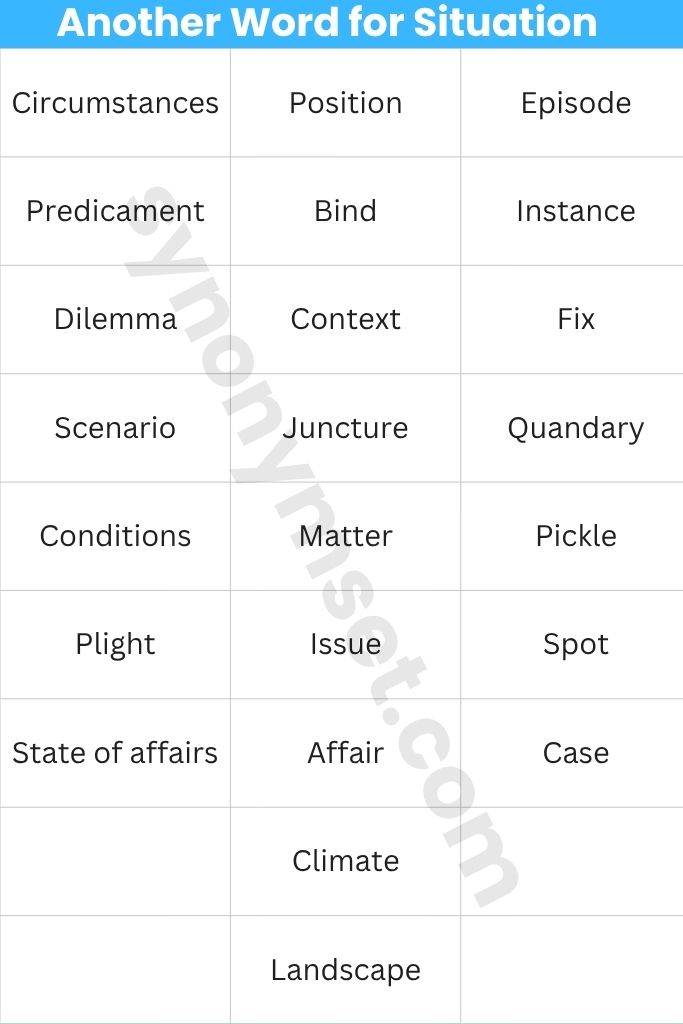
| Alternative | Best when… | Tone |
| Circumstances | External factors beyond one’s control | Neutral to formal |
| Predicament | A difficult situation with no clear escape | Slightly dramatic |
| Dilemma | A choice between two uncomfortable options | Neutral to serious |
| Scenario | A projected or described case | Neutral, analytical |
| Conditions | Ongoing environmental or structural factors | Neutral, descriptive |
| Plight | Suffering or hardship deserving sympathy | Emotive, serious |
| State of affairs | A general assessment of how things stand | Slightly formal |
| Position | Where someone stands relative to others | Neutral to formal |
| Bind | An awkward or tricky situation | Informal, colloquial |
| Context | The surrounding factors that shape meaning | Neutral, analytical |
| Juncture | A critical or defining moment | Formal, emphatic |
| Matter | Something requiring attention or discussion | Neutral, direct |
| Issue | A problem or point of contention | Neutral to slightly formal |
| Affair | A matter of some social or organizational weight | Formal, sometimes euphemistic |
| Climate | A prevailing mood or atmosphere across a group or period | Figurative, formal |
| Landscape | A broader overview of a field or environment | Figurative, analytical |
| Episode | A distinct occurrence within a longer series | Neutral to narrative |
| Instance | One specific example or occurrence | Neutral, precise |
| Fix | Informal term for a difficult situation | Casual, expressive |
| Quandary | A state of mental uncertainty about what to do | Neutral to slightly formal |
| Pickle | Light, often humorous difficulty | Informal, playful |
| Spot | Informal for a difficult position | Casual |
| Case | A specific instance being examined or managed | Neutral, often professional |
Another Word for Situation Grouped by Meaning
When You Mean Difficulty or Trouble
Predicament implies being stuck — the difficulty comes from the fact that none of the options are good. “She found herself in a predicament: leaving meant abandoning the team, staying meant missing her flight.” Use this when the situation involves being trapped by circumstances.
Dilemma is sharper: it requires two options, both of which carry a cost. Avoid using it loosely to mean any difficult situation — “It’s a real dilemma” loses meaning if no genuine choice is involved.
Quandary sits close to dilemma but emphasizes mental uncertainty more than the structure of a choice. The person in a quandary doesn’t know what to do; the person in a dilemma knows they have to choose, just not which way.
Bind and fix are informal. “We’re in a bit of a bind” softens the seriousness. “He got himself into a fix” suggests the person bears some responsibility for the mess they’re in.
Plight carries emotional weight — it implies suffering and usually invites sympathy. It works in journalism and persuasive writing: “the plight of displaced families” is not interchangeable with “the situation of displaced families.” The former calls on the reader to care.
Pickle is too light for any genuinely serious context. Save it for friendly, conversational, or humorous writing.
When You Mean Surrounding Factors or Context
Circumstances refers to the conditions that exist around an event or decision — things you didn’t necessarily choose. “Under the circumstances, he made the right call” implies that external forces shaped the situation. It often carries a tone of explanation or justification.
Conditions works for ongoing, measurable, or environmental factors: working conditions, economic conditions, weather conditions. It fits better when the factors can be observed or tracked over time.
Context is not really a synonym for situation — it explains the surrounding information needed to understand something. Don’t substitute it directly: “The context was difficult” means something quite different from “The situation was difficult.”
Climate and landscape are figurative. “The political climate” or “the competitive landscape” describe broad, ambient conditions rather than a single event. They suit analysis, journalism, and professional writing but feel overblown in a sentence describing something specific and immediate.
When You Mean a Specific Moment or Instance
Scenario describes a case — often projected, described, or analyzed. It fits planning contexts: “In a worst-case scenario…” or “Walk me through the scenario.” It sounds analytical rather than urgent.
Juncture signals that the moment matters: “At this juncture, we need to decide.” It’s formal and slightly weighty — reserve it for genuinely significant crossroads. Using it for minor decisions makes it feel inflated.
Episode implies one part of a larger sequence. It works in narrative or medical contexts (“a depressive episode”) and in storytelling, but it can feel oddly detached in professional writing.
Instance is precise and slightly formal. Use it when you’re referring to a single, specific occurrence: “In this instance, the rule doesn’t apply.” It doesn’t carry any emotional tone.
When You Mean a Matter Requiring Attention
Matter is clean and direct. “This is a serious matter” is less wordy than “This is a serious situation.” It works well in professional emails, legal language, and formal communication.
Issue is slightly more contentious — it often implies a problem or point of disagreement. “We need to address the issue” suggests something has gone wrong. If nothing has actually gone wrong, issue can introduce an unintended tone of concern.
Affair is formal and somewhat old-fashioned in everyday use, but still common in phrases like “the whole affair” or “a complicated affair.” It can also sound euphemistic: “the affair was handled badly” sometimes implies something was covered up.
Case suits professional and analytical contexts — medical, legal, journalistic. “In this case” is clear and direct. It’s not the right choice when describing something personal or emotional.
When You Mean Where Someone Stands
Position captures both physical and figurative location. “Her position in the negotiation was strong” or “He was in a difficult position” — both work naturally. It fits professional, strategic, and interpersonal contexts.
State of affairs is slightly formal but expressive. It often comes with an evaluative tone: “The current state of affairs is unsustainable.” It suggests the speaker is assessing how things stand across a period or system, not just describing a single moment.
Words That Look Like Substitutes but Aren’t
Scenario vs. situation: A scenario is described or imagined; a situation is occurring. “Let’s consider a scenario where sales drop” — that scenario isn’t happening yet. “We’re in a difficult situation” — this is present reality.
Dilemma vs. predicament: A dilemma is specifically about a choice. A predicament is about being stuck. “I’m in a dilemma between the two job offers” is correct. “I’m in a predicament — I took the job and now regret it” — here, the choice is already made, so dilemma would be wrong.
Plight vs. predicament: Plight emphasizes suffering and asks the reader for sympathy. Predicament is more neutral. “The refugees’ plight” calls for compassion. “The negotiators’ predicament” is just a description of difficulty.
Circumstances vs. conditions: Circumstances are specific surrounding facts; conditions tend to be broader and more measurable. “Given the circumstances” points to particular contextual details. “Under these conditions” suggests an environment that persists.
Another Word for Situation Choosing by Context
In professional writing or emails: matter, issue, position, case, circumstances
“I wanted to follow up on this matter” reads more cleanly than “I wanted to follow up on this situation.”
In persuasive writing or journalism: plight, state of affairs, juncture, circumstances
These carry enough weight to signal importance without sounding vague.
In analysis or planning: scenario, context, conditions, landscape
These signal that you’re examining something carefully rather than just describing it.
In fiction or narrative: predicament, bind, episode, juncture, affair
These carry dramatic weight or narrative texture that situation lacks.
In casual conversation or informal writing: fix, bind, pickle, spot
Light and human. Don’t use them where seriousness is expected.
Practical Decision Guide
| If you mean this… | Use this |
| Something difficult with no easy exit | predicament |
| A forced choice between two bad options | dilemma |
| A moment of particular significance | juncture |
| A specific case being examined | case, instance |
| Factors beyond your control | circumstances |
| How things stand broadly | state of affairs |
| Suffering that deserves empathy | plight |
| An informal, mild difficulty | bind, fix |
| Background information shaping a decision | context |
| A projected or described event | scenario |
| Something requiring action or resolution | matter, issue |
A Note on Repetition
If situation is appearing repeatedly, the real problem may not be the word itself but the underlying sentence structure. Vague words tend to cluster around vague thinking. Before replacing situation, ask whether the sentence could be rewritten to describe what specifically is happening rather than labeling it. Often, the best solution isn’t a synonym — it’s a clearer sentence.
That said, when you genuinely need a replacement: match the type of difficulty to the word, watch the tone, and choose the one that carries exactly as much weight as the sentence requires — no more, no less.
Read also about these:
Another Way to Say “Such As”: Alternatives, Usage & Examples
Another Word for Even Though: Alternatives That Work in Your Sentence
Another Word for Empathy: Find the Right Word for Your Meaning
Courtesy vs Curtesy: Two Different Words, Not a Spelling Choice

The Eddy’s writes clear, practical content about synonyms, alternative words, spelling, and correct word usage. Their goal is to help readers find the right words, improve writing, and communicate with greater confidence through useful, easy-to-understand language guidance.